YAQSI#
This page aims to provide a brief overview of the YAQSI (yet another quantum simulator) embedded in our package.
The simulator aims to be fully abstracted by the Model class, so for most usecases, it should not be required to interact with the simulator directly.
However, some scenarios require building a custom circuits or require more granular control.
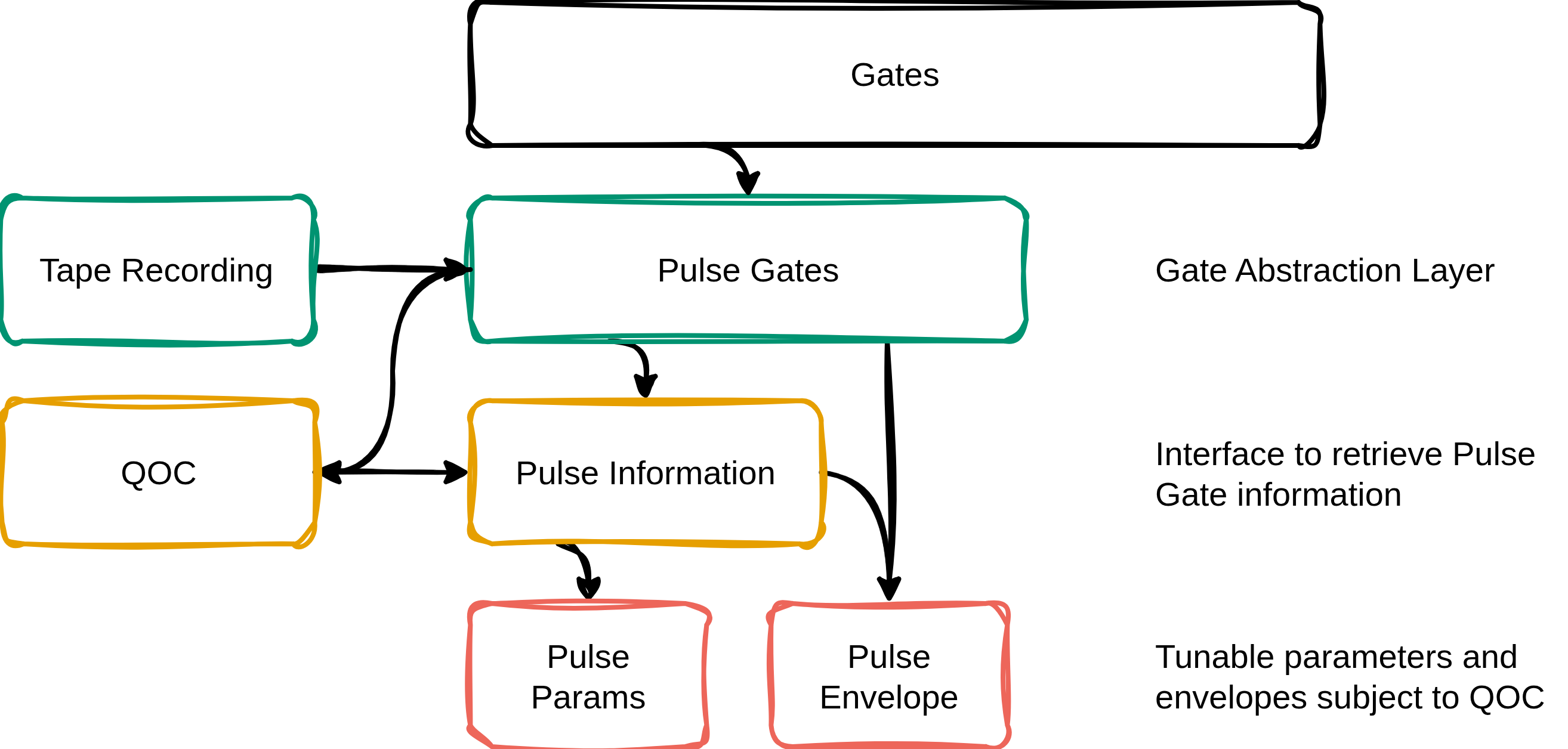
In the figure below, you can see how YAQSI provides the Foundation for the more standard interfaces Model, Ansaetze and Gates.
With the latter two being responsible of constructing quantum circuits and therefore interface direction with the Operations module of YAQSI, Model interfaces with the Script class, the main interface for circuit execution.
Generally, all operations are registered on a Tape when being created in the context of a Script (see examples below).
All matrix definitions (including Kraus channels for noisy simulation) are registered in the Operations module.


While the standard gate execution is quite straight-forward, the pulse simulation requires a bit more care.
Here we split up PulseGates (abstracted by the Gates class) into PulseParams and PulseEnvelope to get more fine grained control over the underlying implementation.
As a single source of truth for both, there is the PulseInformation class, providing valid combination of these two characteristics.
The API of our simulator is very similar to what one might be used to know from pennylane. For a basic circuit execution, we have to do two imports:
Next, we can create a circuit and specify the observable:
Finally, creating a Script and excute it will give us the probabilities for this standard Bell-Circuit:
Parameterization of circuits is straightforward; you just have to pass the args to the execute function:
import jax.numpy as jnp

n_qubits = 1

def circuit(phi, theta, omega):
    op.Rot(phi, theta, omega, wires=0)
    op.Rot(jnp.pi, 1/2*jnp.pi, 1/4*jnp.pi, wires=0)

obs = [op.PauliZ(wires=i) for i in range(n_qubits)]
yss = ys.Script(circuit)
yss.execute(type="expval", obs=obs, args=(jnp.pi, 1/2*jnp.pi, 1/4*jnp.pi))
Training those circuits is a breeze as we entirely build upon JAX and can just use OPTAX for this purpose:
import optax as otx

def cost_fct(params):
    phi, theta, omega = params
    return yss.execute(type="expval", obs=[op.PauliZ(0)], args=(phi, theta, omega))[0]

params = jax.numpy.array([0.1, 0.2, 0.3])
opt = otx.adam(0.01)
opt_state = opt.init(params)

for epoch in range(1, 101):
    grads = jax.grad(cost_fct)(params)
    updates, opt_state = opt.update(grads, opt_state, params)
    params = otx.apply_updates(params, updates)

    if epoch % 10 == 0:
        print(f"Epoch: {epoch}, Cost: {cost_fct(params):.4f}")
Beyond this, you can conveniently call .dagger() or .power() on operations, ...
def circuit():
        op.RX(0.5, wires=0)
        op.RX(0.5, wires=0).dagger()
        op.PauliX(wires=0).power(2)

obs = [op.PauliZ(0)]
yss = ys.Script(circuit)
res = yss.execute(type="expval", obs=obs)

print(res) # we expect to end up in |0⟩ again
or combine them with different noise channels:
def circuit():
    op.H(wires=0)
    op.CX(wires=[0, 1])
    op.DepolarizingChannel(0.1, wires=0)
    op.DepolarizingChannel(0.1, wires=1)

yss = ys.Script(circuit)
rho = yss.execute(type="density")
purity = jnp.real(jnp.trace(rho @ rho))
print(purity) # Purity should be < 1
As Pulse Gates are built entirely upon YAQSI operations, you can also use those in the circuit to perform pulse level simulation:
from qml_essentials.gates import PulseGates

def circuit(w):
    PulseGates.RX(w, wires=0)

obs = [op.PauliZ(0)]
yss = ys.Script(circuit)
res = yss.execute(type="expval", obs=obs, args=(jnp.pi*0.5,))
print(res) # expect sth. around 0 (but not too close)
Mixing pulse level simulation with noisy simulations is possible as well:
def circuit(w):
    PulseGates.RX(w, wires=0)
    PulseGates.RY(w, wires=0)
    PulseGates.CX(wires=[0, 1])
    op.DepolarizingChannel(0.1, wires=0)
    op.DepolarizingChannel(0.1, wires=1)

yss = ys.Script(circuit)
res = yss.execute(type="density", args=(jnp.pi*0.5,))
purity = jnp.real(jnp.trace(rho @ rho))
print(purity) # Purity should be < 1
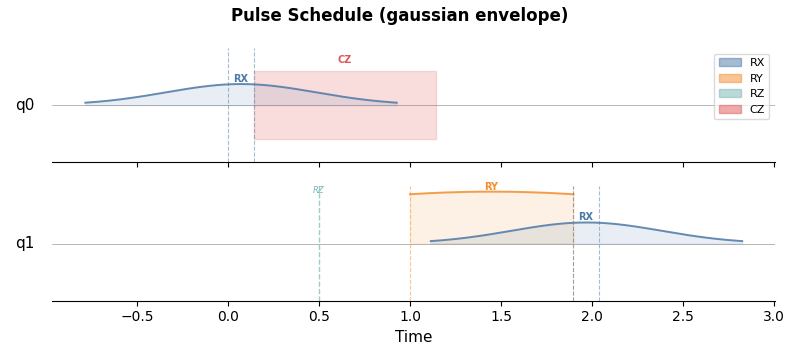
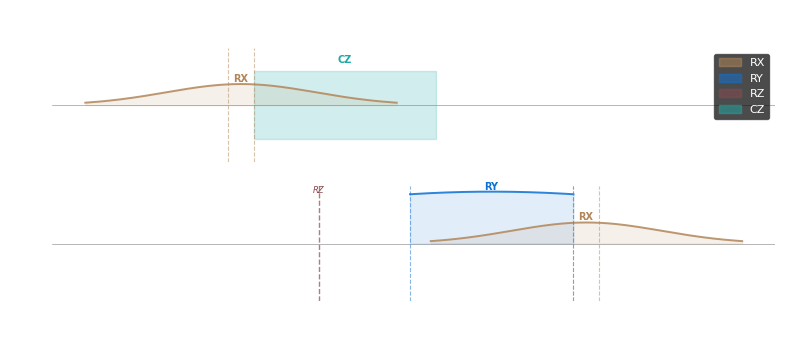
You can visualize the pulses schedules, i.e. the sequence in which the pulses are applied on each qubit in the circuit, using the draw method.
Here, shaded areas represent the pulse shape/envelope (e.g. "Gaussian") of the pulse and the vertical line represents the time at which the pulse is applied.
Note that all gates are automatically decomposed into basis gates (e.g. H is decomposed into RZ and RY).
def circuit(w):
    PulseGates.RX(w, wires=0)
    PulseGates.CZ(wires=0)
    PulseGates.H(wires=1)
    PulseGates.H(wires=1)

yss = ys.Script(circuit)

fig, axes = yss.draw(figure="pulse", args=(jnp.pi*0.5,))
Performance: pulse-level gradient throughput#
The pulse-level pipeline is compiled with JAX/XLA, but the underlying
ODE integration is sequential by construction: each Adam step
performs a diffrax.Dopri8 solve over the gate duration, and the
adaptive step controller cannot be parallelized across time. That
means a single value_and_grad(loss)(params) call typically saturates
one CPU core — multi-threading helps only inside per-step matrix
products (which are tiny: 8×8 for three qubits) and across batched
restarts (vmap).
The performance can be tuned on following different levels:
-
PulseInformation.set_rwa(True)— opt-in rotating-wave approximation. Drops the fast counter-rotating terms in the interaction-picture Hamiltonian. Default isFalse(exact integration). -
Yaqsi.set_solver_defaults(solver=...)— opt-in commutator-free Magnus integrator on a fixedlax.scangrid.
No RWA, exactH_I(t), but trades the adaptive Dopri8 step controller for a fixed grid ofmagnus_stepssubsteps that fuses into a single XLA program — eliminating per-step Python overhead and host↔device sync entirely. -
solver="dopri8"(default): adaptive Dormand-Prince 8(7). solver="magnus2": midpoint Magnus, oneexpmper step. Second-order: error scales ash^2.solver="magnus4": Blanes-Moan CFM4:2, twoexpmper step. Fourth-order: error scales ash^4(≈16× drop per N doubling). Typically the best accuracy/cost trade-off for smooth oscillatory pulse drives —magnus_steps=512reaches ≲1e-7 error on a standardRX(\\pi/2)Drag pulse.
Both Magnus integrators preserve unitarity to machine precision
regardless of step size. Choose magnus_steps so that
h = T/N resolves the fastest oscillation in H(t)
(a few steps per period of \\omega_c + \\omega_q).
from qml_essentials.yaqsi import Yaqsi
Yaqsi.set_solver_defaults(solver="magnus4", magnus_steps=512)
-
PulseInformation.set_frame("drive")— algebraic rewrite of the (non-RWA) coefficients via the product-to-sum identitycos(\\omega_c t) cos(\\omega_q t) = 1/2[cos(\\Delta t) + cos(\\Sigma t)]with\\Delta = \\omega_c - \\omega_q,\\Sigma = \\omega_c + \\omega_q. Mathematically identical to the default"lab"form (no information lost, no RWA applied). Primary use: combined withmagnus2/magnus4, the explicit slow/fast decomposition is sometimes numerically better-conditioned when the drive is detuned (|\\Delta| << |\\Sigma|). Switching the frame does not change the result of an adaptive solve. -
XLA / OMP thread settings. Even on a single ODE solve, XLA can parallelise some matmul-heavy reductions if you allow it to. Reasonable defaults for a workstation:
export XLA_FLAGS="--xla_cpu_multi_thread_eigen=true \
                  intra_op_parallelism_threads=$(nproc)"
export OMP_NUM_THREADS=$(nproc)
For dim <= 16 (<= 4 qubits) the per-step matmuls are too small to
benefit much from threads; the dominant gain comes from vmap
parallelism.
Diagnostic helper#
qml_essentials.qoc.profile_pulse_pipeline(gate, rwa=...) builds a
minimal pulse Script for the requested gate, JIT-compiles a
forward + value_and_grad pass, and prints wall-clock timings for
both compilation and steady-state evaluation: